 |
| Dunham Massey in 2014 |
|
| Dunham Massey in 2014 |
 |
 |
 |
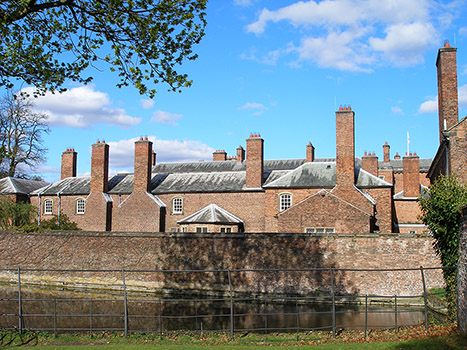
| View across the lake approaching from the car park | Gate into the courtyard | |
 |
 |
|
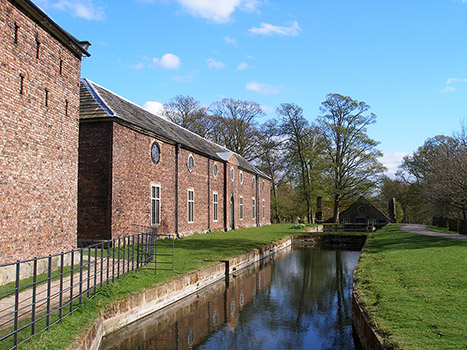
| Stable block to the north of the clock tower | Front of the house | |
 |
 |
|
| Entrance to the services court | Statue in front of the house | |
 |
 |
|
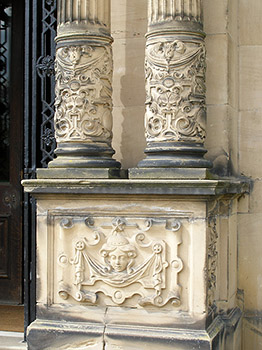
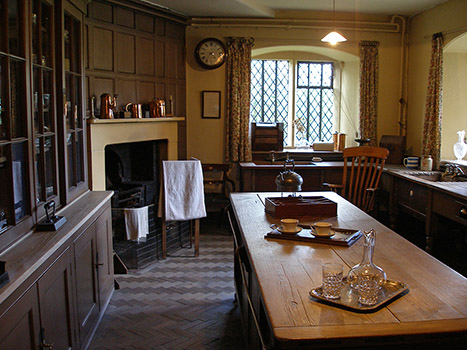
| The kitchen | Columns by the front door | |
 |
 |
|
| Butler's Pantry | South range from inner court |
Dunham Massey has been in the hands of the National Trust since 1976 and has its own website. Pevnser in his book on Cheshire states that there was a Norman Castle on the site. A chapel is known to have existed in 1307. Sir George Booth (1566-1652) often referred to as Old Sir George, to distinguish him from his grandson, built a house around a courtyard in the early 17th century. The south side of this building was not erected until the time of the 1st Lord Delamere in about 1655. Little remains now from the 17th century. The stables date from about 1720 and the Service Court has some similar features suggesting that it also dates from this time. The main house was remodelled by John Norris between 1732 and 1740 in the time of George, 2nd Earl of Warrington. In 1822, John Shaw created a bow window on the east side. Further alterations were made by Joseph Compton Hall in the Edwardian Period. The north side has eleven bays and a pediment covering three bays of stone. The Great Hall is in the south range, with the full height windows shown in my photograph at the bottom right hand side.
The House stood empty for about 50 year at the end of the 19th century. Since 2010, photography has been allowed inside Dunham Massey for personal but not commercial purposes. This site had no commercial element but I show just two interior shots from the service wings and recommend that readers pay a visit to see the furniture and many fine pictures.
The area of Dunham Massey was originally called just Dunham but was given the Massey addition to distinguish it from another Dunham near Chester. The family that settled there took their name from Masci in Normandy. The last baron was Hamon who died in 1341. A complicated sequence of events then took place for Hamon de Massey and his wife Joan, having no issue, had sold the reversion of the manor to Oliver de Ingham, a judge of Chester. However, Hamon had four sisters, Cicely had married John Fitton of Bollin, Isabel married Hugh Dytton, a third sister married Thomas de Lathom and a fourth married Hamon de Hilond. On the death of Hamon, Richard Fitton and the heirs of the other sisters tried to seize the manor as Oliver de Ingham was in France during the early years of the Hundred Years' War, serving Edward III. However, in due course, the king ordered Hamon Massey of Tatton to ensure that Oliver de Ingham gained possession. After Oliver's death, Richard Fitton and his cousins tried again and a legal battle ensued. Eventually, Henry, Duke of Lancaster, bought out all the heirs of Oliver de Ingham and those of Hamon de Massey and gave the manor of Dunham to Roger le Strange, Lord of Knocking.
I believe that the statue of a black boy, "taking the knee", in front of the house, has recently been removed but I retain the picture to show how it stood for many years.
The descent from the Masseys through the Fitton and Venables and eventually to the Booths and De Traffords is shown below.
The two couples in generation 6 above, Sir Edmund Trafford and his wife Alice and Robert Booth and his wife Dowse, partioned the lands of Sir William Venables. Sir Edmund and Alice had Morley, Chorley and Hough and the rents and services of Thomas Pownall, Richard Fitton and William de Honford, the rent and service of Sir Lawrence Fitton of Gawsworth for his lands in Bollin Fee and also all the lands which Sir William Venables had held in Norden and Helsby and the advowson of Wilmslow Church.
Robert Booth and his wife Dowse had Styal and Dean Row and all the lands that Sir William Venables had held in Fallibroome, Norley, Oneston, Kingsley, Arrow, Picton, Stoke and Chester and also the manor house of Thornton and the advowson of Thornton church together with Bollin Mills. Robert Booth, later Sir Robert then made a bid for the lands of Dunham Massey which he felt should have descended to him via the Massey family, Fittons and Venables. Eventually an agreement was made between Sir Thomas Stanley, Sir Robert Booth and William Chauntrell, serjeant-at-law, that half the manors, lands, rents and services in Dunham, Hale and Altrincham would remain with Sir Thomas Stanley and William Chantrell and the other half go to Sir Robert Booth and his co-feoffees. His heirs later made purchases so that by the time Sir Peter Leicester was writing his history of the county, George Booth, Lord Delamere, had the manor of Dunham Massy. There are documents surviving from the arrival of the Booths showing that the estate had been neglected since the demise of the Masseys. The hall was on a moated site. The Booths were from Boothstown in Salford.
The family of Booth at Dunham Massey was one of the most influential Cheshire families in English history because of the Booth Rebellion and the subsequent role played by George Booth in the Restoration of King Charles. They Booths rose to prominence in the 16th and 17th centuries. Old George Booth and his grandson, young George Booth were two of the principal players in this advance. Old George Booth lived to be 80, dying in 1652, and married three times. He outlived his son, who died in 1632, and was succeeded by his grandson. Old George Booth married heiresses and established the family on a firmer financial basis. His marriage to Elizabeth Carrington brought land south west of Manchester which linked Dunham to Boothstown. Old George built the Elizabethan house at Dunham and made it the family seat.
In 1618, George Booth bought a baronetcy from James I as did his son-in-law, Henry Brereton of Handforth. James I pressured gentry of suitable standing to purchase baronetcies for £1,000 and used the money for his settlement of Scottish presbyterians in Ulster. This gave the families and inheritable title but not a seat in the House of Lords. The Booth family were on the low church side of Anglicanism and wary of the innovations of Charles I and Archbishop Laud. They supported Parliament in 1642 but became disillusioned by the end of the Protectorate. Young George Booth was excluded from Parliament by Pride’s Purge of 1648 because he favoured continued negotiations with the king. Both George’s retired to Dunham. Old George died in 1652 leaving the family wealthy from his marriages, with an hereditary title and his children married into the Cheshire gentry.
After the death of Oliver Cromwell and the resignation of his son Richard, there was great uncertainty and George Booth was one of the men behind what became known as Booth’s Rebellion. He favoured the idea that parliament be allowed to decide how the country should be run, and privately believed that they would call for the Restoration of the Monarchy. In this regard he made common cause with royalists like Peter Leicester of Tabley. Booth’s colleague in instigating this move was at Chirk Castle and he made the mistake of calling directly for the Restoration. The rebellion was put down but the next year, following the march to London of the army under Wade, the decision was made to invite Charles to return and Booth was one of the delegation sent over to the Hague to organise it. He was rewarded by becoming Lord Delamere, having had no part in the execution of Charles I. However, Booth disliked the frivolity of the Restoration Court.
Being from the Low Church, the Booths favoured Monmouth against James II. The future 2nd Lord also favoured Monmouth and was also suspected of involvement in the Rye House Plot. In 1684, Young George Booth died. The 2nd Lord Delamere was accused of treason over the Monmouth Rebellion. He was imprisoned in the Tower of London and pawned the family silver to purchase legal help. The case did not come to trial as no evidence was found against him and he returned to Cheshire. In 1688, William of Orange landed and the 2nd Lord formed a regiment and called on other Cheshire gentry to support him. They marched down to join William and in gratitude he was made Earl of Warrington. Lord Delamere was one of three peers who went to see James II to ask him to leave. He then returned to Cheshire, became Lord Lieutenant and organised the army for its expedition to Ireland. James was defeated in 1690 at the Battle of the Boyne. However, by this stage, the Booth family were in financial difficulty.
In 1694, the first Earl died with £50,000 of mortgages. The 2nd Earl needed to marry well and met John Oldbury who had made a fortune in the East India Trade. Oldbury had no son but two daughters and was eager to marry them into the aristocracy. They were reputed to be worth £40,000 apiece. Warrington married Mary Oldbury, but the two were not temperamentally suited. She was not very well educated or refined and Warrington was reserved and shy. As a consequence, they lived at opposite ends of the house and had one child, a daughter, Mary Booth, who was the apple of her father’s eye. He did not want her to lose her money as her mother had done, so he had it tied up for her children to inherit. Mary Booth married the Earl of Stamford, whose family name was Grey, with a marriage settlement to ensure he got no control of her capital. Mary ran her own financial affairs. Eventually the Grey family gained the estate through the inheritance of Mary’s son. The Grey’s seat was at Enville.
The following family tree is taken from Ormerod's History of Cheshire and from the National Trust brochure on Dunham Massey. Note that there was a marriage connection with the Grey family at the time of the 1st Baron Delamere.
Robert Booth was rector of Thornton, archdeacon of Durham in 1691 then Dean of Bristol. He married Anne daughter of Sir Robert Booth of Salford and had a son Henry who died in infancy. With his second wife Mary, daughter of Thomas Hales of Howlet in Kent he had Mary (died unmarried) Elizabeth, (wife of Charlton Thruppe) and Vere (wife of George Tyndale of Bathford). Their sons were Robert, George, Edward and Nathaniel Booth of Hampstead. The latter succeeded to the title of Lord Delamere in 1758 but died without issue.
I am grateful to Gavin Lucas for pointing out an error in relation to Cecily. When the Ormerod's volume on the History of Cheshire was revised by Thomas Helsby in 1882, he made additions and corrections in footnotes rather than in the main text, and I had overlooked these in relation to Cecily. Gavin has studied this subject intensively and found extensive evidence that Cecily was the sister, not the daughter of Hamon de Massey as Ormerod had first reported. I summarise Gavin's main points below:
Cecily was co heiress of the last Baron Hamon de Massey V1 (about 1246-1341), who married Alice de Beauchamp (b. about 1244) after his first wife Isabelle (Alice’s sister) died on their wedding night. He later divorced Alice & married as his 3rd wife Joan (no children). The historians Sir Peter Leycestor & George Ormerod mention (Ormerod volume 1 page 522) that in the lines of descent for the heirs of Fitton, Cecily was the last Baron's daughter & Co heir. However, Thomas Helsby revision of Ormerod's work in 1882 made additions and alterations showing that Cecily was in fact the "SISTER" of the last Baron. In George Ormerod's "Additions" (volume 1 page 526), it is stated that the Will of Dunham Massey - mentioned in the Domesday Book, records a different picture of the lines of descent to that of Sir Peter Leycestor. George Ormerod states after translating the Will, that: It may be assumed from this, that "the daughters of Hamon V1" mentioned by Sir Peter Leycestor as occurring in an old role, were in fact his sisters. Thomas Helsby in his following footnotes to this (volume 1 page 527), also clears up a number of other points of earlier contention. It is certainly proven to be the case that Cecily was the eldest of 4 sisters of the last Baron & who contested the last Baron's Will after the death of the Baron's illegitimate heir in Gascony & the Reversion of the Manor of Dunham to Oliver de Ingham. The evidence of this fact is in the actual "Pedigree" of the family of Fitton of Bollin & Gawsworth (volume 3 page 552). It can be seen that the descendents of Fitton have themselves contested this same point & have permitted the inclusion of a specific acknowledgment that Cecily was the "Sister" of the Baron. Further evidence to support this view are the dates for the lives of descendants, however, this must be seen in the light of the following statement by Helsby:- Helsby records in his additional sub notes (volume 11, p367), that the dates for the Barons of Massey lineage, recorded in the pedigree of the Dunham Estate provided by Sir Peter Leycestor "are far from satisfactory" & are not set in stone, especially the dates for the earlier Masseys until Edward 2nd. He says the dates given by Sir Peter Leycestor for the generations of 6 Barons over two centuries is probably very unreliable in terms of their accuracy!
So we have:
Baron Hamon de Massey V1.(about 1246-1341) - d.15 Edw 3rd. volume 1. p522.
Baron's Sister Cecily (b. about 1268) Cecily married 1st Thomas Orreby (died) married 2nd John Fitton (died about 1346)
Issue of Cecily & John Fitton = Richard Fitton (living in 1348, served in Gascony 1370 & Calais 1372 - Ormerod). Ormerod states in volume 1 on page 522, " But now fell great suits concerning the Barony of Dunham-Massey after the death of Hamon & Joan without issue of their bodies, for Richard Fitton, & the heirs of the other sisters, entered into the Manor of Duham, as heirs to the said Hamon". A very important point here is that at this time of the last Baron's death in 1341, both Cecily & John Fitton were in their 70's & unlikely to risk any concerted physical action themselves, which is why their much younger son & heir Richard is noted in the records as acting on behalf of his co-heir Mother Cecily. If Cecily was the daughter of Hamon, then it would seem more likely that being of a much younger age, both she & John Fitton would have embarked on this course of action themselves & not otherwise relying on their son, Richard.
The 7th Earl of Stamford, highlighted above, succeeded his grandfather at the age of 18. The family fortunes had been turned round to the degree that he had an income of £60,000 a year. His first wife was Bessy Billage, the daughter of his servant at Cambridge. She died young and he then married Kitty Cocks, a circus equestrienne. Her brother had been convicted of grevious bodily harm. Kitty was beautiful and intelligent but did not go down well with the new Victorian middle-class in Bowden. She was also rejected by many of the Cheshire gentry. The Earl decided to leave Cheshire, live at Enville, the Grey's family seat and rebuild it. No Stamfords lived at Dunham from 1855 to 1905. The Earl enjoyed horse racing and moved with the set around the Prince of Wales, later Edward VII. In these circles, where the Prince might be entertained for the weekend (not always with his wife), Kitty could act as hostess in a way not possible among the more conservative gentry in Cheshire. The Earl knew that the estate would be inherited by his cousins and arranged to leave as much as possible away from them. Kitty had a life interest in the estate and her family were to get Enville. In the 1850s he had arranged to sell land in the Wilmslow area that was not entailed and this led to the development of the town in the early years of the railway.
The 8th Earl was a missionary Bishop in South Africa. His third wife, and the mother of his children was his African housekeeper. They had two illegitimate children and one born after the marriage. In the Boer lands they had the Code Napoleon that legitimised children when the parents married. However, this did not apply in England and so the children were referred to as Ann, John and Lady Mary. The House of Lords decided that John was not legitimate so on the death of his father the title and estate went to his cousin. The 9th Earl’s wife was a the daughter of a clergyman and seems to have taken to being countess with great zeal. She was a determined and outspoken woman. The African children were paid off and John became a solicitor in Worthing. The 9th Earl moved to Dunham in 1905 as it was the only large house now with the estate. They used the architect, Chapman Hall, to alter the frontage with the stone entrance and the Mansard roof. The Countess was alway eager to emphasise the Grey’s Elizabethan forebears including Lady Jane Grey, who lived at Bradgate in Leicestershire.
The 10th Earl was Roger, who was unmarried. He arranged before his death for the property to go to the National Trust as his nephew did not want it. The 10th Earl’s sister married a clergyman, the Rev. Turnbull, at Hever in Kent.
 |
| The Watermill at Dunham, 18 November 2014 |
The church serving Dunham Massey is St. Mary the Virgin at Bowdon. A church was recorded at Bowdon in the Domesday Book. The Wikipedia article states that it is likely that a new church was built in the 14th century and remodelled in the 16th century. The church was completely rebuilt between 1858 and 1860 by W. H. Brakspear, although the 16th-century roofs of the aisles were retained and incorporated into the new structure. The church has the tombs of several prominent Cestrians including Henry Booth, 1st Earl of Warrington who died in 1694 and his wife Mary, shown above in Generation 4.
 |
|
 |
| Church of St. Mary the Virgin , Bowdon | View showing the porch and cross. |
Sources:
The
History of the County Palatine and City of Chester, incorporated with a
republication of King's Vale Royal and Leycester's Cheshire Antiquities,
2nd Ed., revised and enlarged by Thomas Helsby, Esq., published by
George Routledge and sons, Ludgate Hill, London, 1882. This is now
available from the Family History Society of Cheshire on CD ROM. A
reprint of the work was published by Eric Morten of Didsbury.
Ormerod, in Volume 1 page 534 gives what he describes as a continuation
of the family tree of Booth, following his usual practice of starting
out from the work of Sir Peter Leicester.
Notes from Cheshire Gentry by Clare Pye a series of lectures held under the aegis of Wilmslow Guild, at Poynton, Autumn 2005.
Dunham Massey, National Trust Brochure.
Wikipedia
Back to list of families
Introduction to Cheshire Gentry

 Strict