 |
 |
 |
| Site of original academy | Oliver Cromwell |
|
|
|
|
| Site of original academy | Oliver Cromwell |
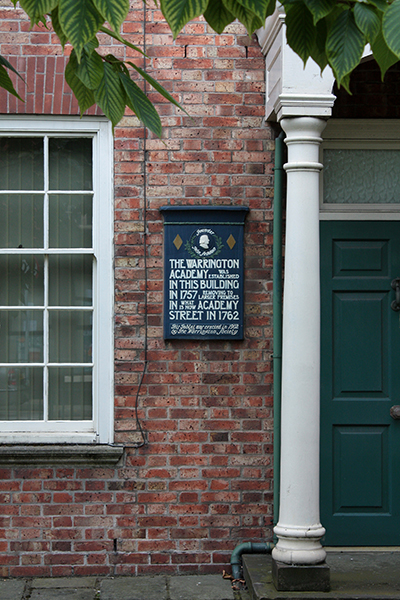
The plaque by the door reads "Founder
John Seddon. The Warrington Academy was established in this building in
1757, removing
to larger premises in what is now called Academy Street, in 1762. This
tablet was erected in 1902 by the Warrington Society."
Secondary education in England in the 18th and 19th centuries was in grammar schools or the public schools such as Repton, Ruby, Eton and Harrow. The grammar schools had often started in the local church where boys were taught by the vicar in a chapel, or sometims in a room above the porch. This education was restricted to those of the Anglican i.e. Church of England, denomination. Nonconformists such as Roman Catholics, Presbyterians, Baptists, Quakers and Unitarians had to make their own arrangements. The two English Universities, Oxford and Cambridge allowed access solely to Anglicans. At this period, the main purpose of these two universities was to train Anglican clergy. The Universities Tests Act of 1871 abolished religious "Tests" and allowed Roman Catholics, Nonconformists and non-Christians to take up professorships, fellowships, studentships and other lay offices at the universities of Oxford, Cambridge and Durham. It also forbade religious tests for any degree, other than a degree in divinity. Prior to this Act of Parliament, the Nonconformists such as Unitarians had to provide not just secondary education but also tertiary education to provide men, and they were exclusively men, to become ministers for their own congregations. John Wesley, founder of Methodism, started as an Anglican and was ordained a minister in the normal manner in 1728. He never broke with the Anglican Church. It was not until after his death that the Methodists separated from the Anglicans and started to ordain their own ministers. The situation in Scotland was different; the four universities, Edinburgh, Glasgow, Aberdeen and St. Andrews allowed students from all denominations and as a result some English Unitarians sent their sons to be educated there or on the Continent in protestant Holland.
In the North West of England
Warrington Academy was set up
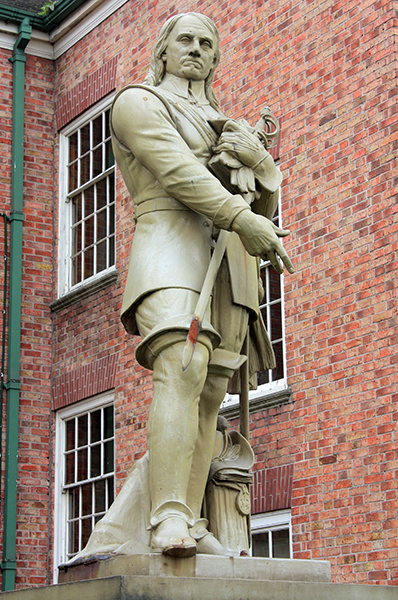
to provide in particular for Unitarians. My pictures show the original site
and the statue of Oliver Cromwell that still stands nearby. It was active as a teaching
establishment from 1756 to 1782, was a prominent dissenting academy, that is, a
school or college set up by those who dissented from the established Church of
England. It was located in Warrington (then part of Lancashire, now within
Cheshire), a town about half-way between the rapidly industrialising Manchester
and the burgeoning Atlantic port of Liverpool. Formally dissolved in 1786, the
funds then remaining were applied to the founding of Manchester New College in
Manchester, which was effectively the Warrington Academy's successor, and in
time this led to the formation of Harris Manchester College, Oxford.
It was called "the cradle of Unitarianism" by Arthur Aikin Brodribb writing in
the Dictionary of National Biography, who went on to say that it "formed during
the twenty-nine years of its existence the centre of the liberal politics and
the literary taste of the county of Lancashire". It was planned in 1753,
to replace other training schools in northern England having funding from the
English Presbyterians: Caleb Rotheram of the Kendal academy died in 1752, and
Ebenezer Latham of the Findern and Derby academy in 1754. It was not,
however, formally constituted until June 1757, when funds had been raised by
John Seddon of Warrington, associated with the Octagon Chapel, Liverpool. The
first site was the Cairo Street Chapel; subsequently the building was a large
red brick house.
Three tutors were chosen initially: John Taylor taught divinity; John Holt,
natural philosophy (i.e. science); and John Aikin,
classics. Henry Willoughby was the first president of the academy. Soon a
fourth tutor was appointed. On the death of Dr. Taylor, in 1761, Aikin
became tutor in divinity, and was succeeded in his old duties by Joseph
Priestley, the Unitarian minister and pioneering chemist who discovered oxygen.
Among the other tutors who at some point joined the staff of the academy were
Anna Barbauld (née Aikin, the daughter of John Aikin), Johann Reinhold Forster,
William Enfield, George Walker, Nicholas Clayton, and Gilbert Wakefield.
The academy hit difficulties, with falling rolls and financial problems leading
to its closure in 1782. The disciplinary issues, coupled with unsettled debates
over the principles of education, had led to a loss of confidence from the
direction of the financial backers. It was formally dissolved in 1786, with the
funds being divided in application to the successor Manchester Academy and the
New College at Hackney, after a plan to amalgamate with the Daventry Academy of
Thomas Belsham had come to nothing.
When the academy was dissolved in 1786, 393 pupils, many of whom entered the
legal and medical professions, had been on the books.
Sources

 Strict
