 |
|
| Carew Castle |
|
|
|
| Carew Castle, Pembrokeshire |
|
|
|
|
| Carew Castle |
|
|
|
|
| Carew Castle, Pembrokeshire |
|
 |
 |
|
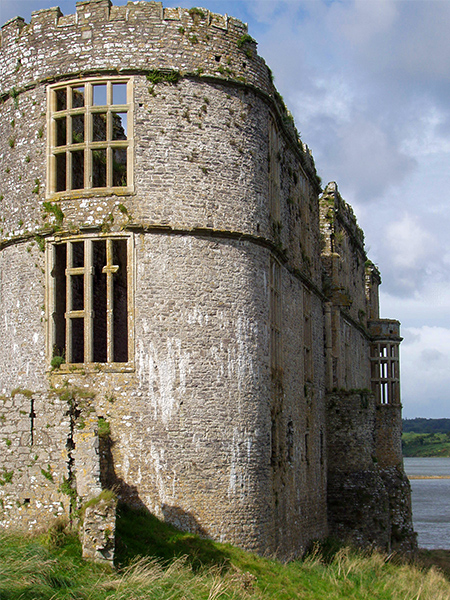
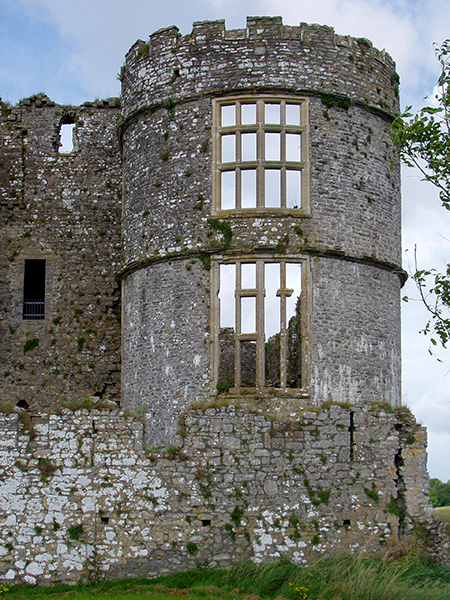
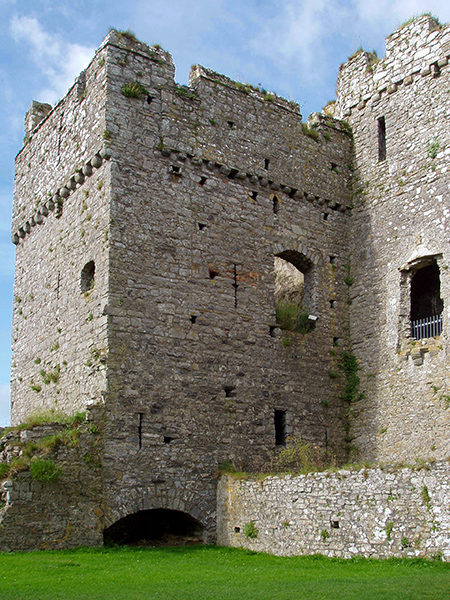
| Rounded cornered tower | Rounded corner | |
 |
 |
|
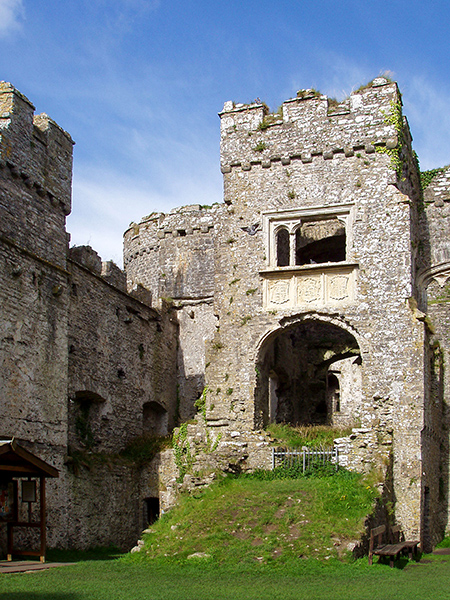
| Square Tower | Interior view |
Carew Castle has a fascinating history in which we see the interaction the old Welsh ruling elite with the new Norman rulers. It is worth recalling that the Norman and subsequent Angevin Kings of England spoke Norman French up until the time of Henry IV, who died in 1413.
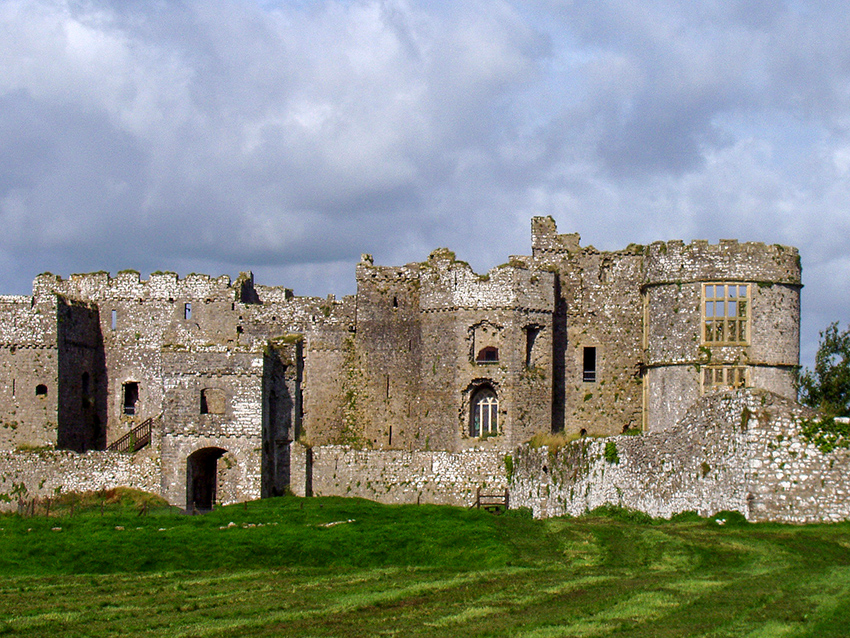
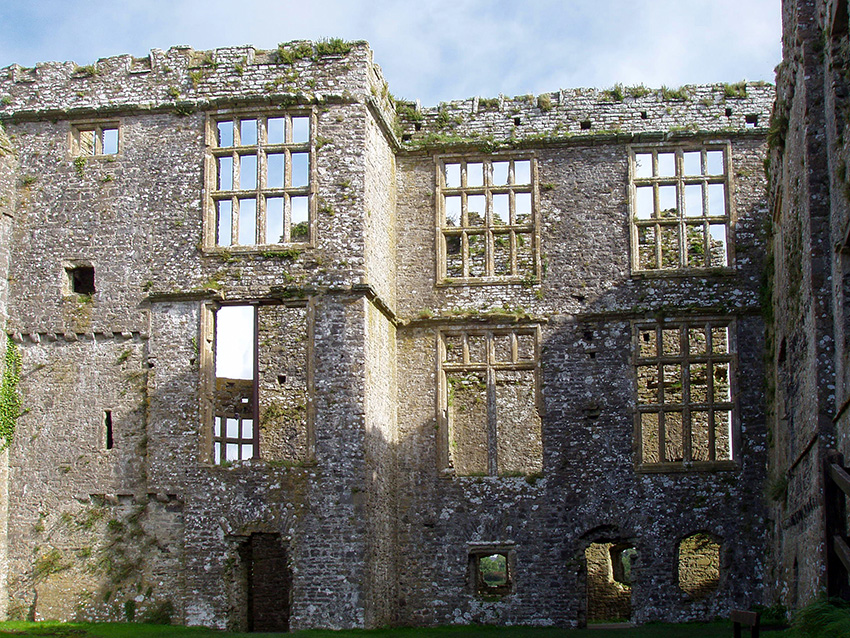
The Norman castle has its origins in a stone keep built by Gerald de Windsor (c.1075 – 1116), around the year 1100. He was the son of the first Norman Constable of Windsor Castle. Gerald was made castellan of Pembroke Castle by Arnulf of Montgomery in the first Norman invasion of Pembrokeshire. He married Nest ferch Rhys, princess of Deheubarth, around 1095. She was the daughter of Rhys ap Tewdwr. Nest brought the manor of Carew as part of her dowry, and Gerald cleared the existing fort to build his own castle on Norman lines. The original outer walls were timber, and only the keep was of stone. This still exists in the later structure as the "Old Tower". Nest had two younger brothers, Gruffydd ap Rhys and Hywel, and, possibly, an older sister named Marared, as well as several older illegitimate half-brothers and half-sisters. After their father's death in battle in 1093, the Kingdom of the Britons fell and was overrun by the Normans. Nest's younger brother Gruffydd was evacuated into Ireland for safety; their brother Hywel may have been captured by Arnulf de Montgomery, along with their mother, unless, as appears likelier, their mother was captured with Nest; their fate is unknown. Two older brothers, illegitimate sons of Rhys, one of them named Goronwy, were captured and executed.
Nest was brought as a prized hostage to the court of William II of England, where she came to the attention of his younger brother Henry Beauclerc (the future King Henry I of England), to whom she may have borne one of his numerous illegitimate children, Henry FitzHenry (c. 1103–1157). Some time after the rebellions of Robert of Normandy and Robert of Belesme, head of the powerful Montgomery family of Normandy and England, the King married Nest to Gerald FitzWalter of Windsor, Arnulf de Montgomery's former lieutenant and constable for Pembroke Castle. In 1102, for siding with the Montgomerys against the King, Gerald had been removed from control of Pembroke, and one Saher, a knight loyal to Henry, installed in his place. When Saher proved unsuitable for his new position, the King restored Gerald to Pembroke in 1105, along with Nest as his wife. By Gerald, Nest is the maternal progenitor of the FitzGerald dynasty, a prominent Cambro-Norman noble family.
Nest's children with Gerald were:
William FitzGerald, Lord of Carew and Emlyn (died c.
1173). William's children included Raymond FitzGerald le Gros.
Maurice FitzGerald, Lord of Llanstephan, Naas and Maynooth, (died 1 September
1177). His children included Gerald FitzMaurice, 1st Lord of Offaly.
David FitzGerald, Archdeacon of Cardigan and Bishop of St David's.
Angharad, who married William Fitz Odo de Barry, by whom she was the mother of
Robert de Barry, Philip de Barry, founder of Ballybeg Abbey at Buttevant in
Ireland, and of Gerald de Barry, better known as Gerald of Wales.
Gwladys, mother of Milo de Cogan
Gerald of Wales, also known by his Latin name as Giraldus Cambriensis, c. 1146 – c. 1223) was a Cambro-Norman priest and historian. As a royal clerk to the king and two archbishops, he travelled widely and wrote extensively. He studied and taught in France and visited Rome several times, meeting the Pope. He was nominated for several bishoprics but turned them down in the hope of becoming Bishop of St Davids, but was unsuccessful despite considerable support. His final post was as Archdeacon of Brecon, from which he retired to academic study for the remainder of his life. Gerald wrote on a variety of topics; his works on Ireland and Wales, which contain details on the culture, contemporary life, and history of those countries, are generally considered the most distinguished. Much of his writing survives. In 1188, while travelling through Wales with the Baldwin, Archbishop of Canterbury, to recruit men for the Third Crusade, he was invaluable as a translator and the party visited leading churchmen and nobles including those at Carew. His account of that journey, the Itinerarium Cambriae (1191) (later followed by the Descriptio Cambriae in 1194) remains a very valuable historical document, significant for the descriptions of Welsh and Norman culture at that time.

 1.0 Strict
